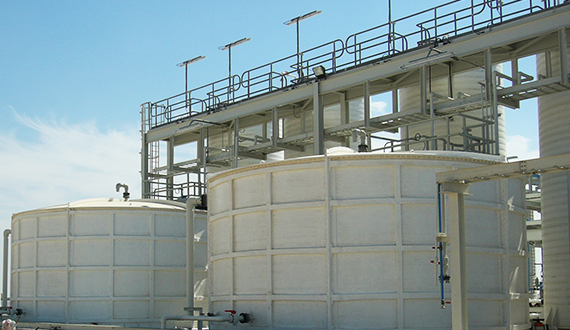
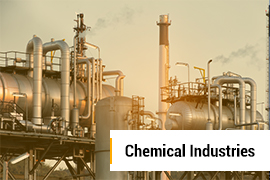
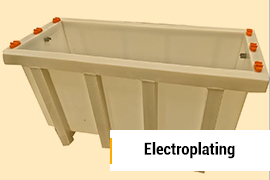
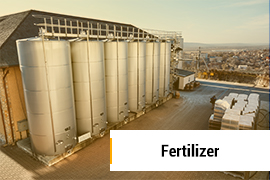
FRP, has become an increasingly popular choice for use in chemical storage tanks. This material boasts many advantages over traditional metal tanks, including excellent chemical resistance, extreme durability, and a huge range of sizes and shapes.
Because of these benefits, more and more companies are turning to FRP for the containment of potentially hazardous chemicals. Additionally, since these tanks are lightweight and easy to install and maintain, they have become a very cost-effective option for many businesses.
Specifications
Conical bottom tanks with steel legs, flanged top, flat top/ flat bottom, dome top/dome bottom.
Horizontal and Vertical Tanks.
FRP flanged nozzles, PN 16 FF.
Dia 600mm – Manhole on top with cover + nuts, bolts & washers.
FRP hold down brackets.
UV resistant.
Tanks with any customised size and design.
MS – GRP laminated lifting hooks.
Product Information
Extraco Chemical Storage Tanks are used for aboveground applications for storage of chemicals such as HCL, NaOCl, NaOH, Cl2, H2SO4, etc., at different temperatures and concentrations.
They are designed for a life of minimum 30 years. Employs the latest design standard EN 13121-3:2016 for checking all loading conditions, stability of tanks under internal and external pressures.
FRP Scrubbers are used in removing some particulates or gases from industrial exhaust streams and also used for the process of control of acid gas emmision and to recover heat from exhaust and flue gases.Our premium range of scrubber system offers complete solution for hazardous gases.
Applicable Standards
Specification Standards
ASTM D 3299
ASTM D 4097
Design Standards
EN 13121-3:2016
ASME RTP-1
BS 4994
Raw materials
Selection of resins will provide the physical and chemical properties. Vinylester resin is usually designed and recommended for chemical storage tanks. It is suitable for chemical and chemical storage tanks.
Extra Co tanks are subject to quality control testing/inspection and thorough checks as per inspection test plan. All incoming raw materials and finished products are inspected and tested in accordance with international standards in line with the inspection test plan.
Manufacturing process
Shell: The Shell is produced by Filament Winding process.
Tank ribs: The tanks construction shall include stiffener ribs to provide sufficient stiffness and rigidity to the tank.
End caps: The end caps are fabricated by contact moulding process.
Assembly: The shell and end caps are then joined together by alternate layers of CSM and woven roving impregnated with resin.